Breast Cancer ChoicesTM |
| . |
| Scrutinizing the evidence for breast cancer procedures and treatments |
| Supplement Strategies - Curcumin |
| These results have staggering implications for human use of curcumin as an adjunctive breast cancer treatment. -- Julius Goepp, MD |
| The Subtraction StrategyTM * Personal Products Dental Detox House Detox Water Detox Breast Detox Addition StrategyTM CoQ10 Curcumin Selenium Enzymes Melatonin Vitamin C Vitamin D Medicinal Foods |
By blocking the activity of this “master switch,” curcumin appears to interfere with the cancer process at an early point, impeding multiple routes of development: reducing the inflammatory response, inhibiting the proliferation of tumor cells, inducing their self-destruction, and discouraging the growth of blood vessels feeding tumors. -- MD Anderson Cancer Center OncoLog September 2007 |
| / |
reverse cancer development at each stage of the disease.
- --from Duvoix, A et al., Chemopreventive and Therapeutic Effects of Curcumin, Cancer
Letters 2005
- Curcumin Reduces Number of Lung Metastases + Makes
1. Acting through The Genes
- In a 2006 study, curcumin suppressed the tumor necrosis factor (TNF),
down-regulating genes that control every stage of cancer development.
These stages include: Cell proliferation, apoptosis, and malignancy. (3)
2. Acting on Cell Proliferation
Curcumin suppresses production of
proteins needed for uncontrolled growth
and proliferation, inflammation and inhibition
of PGE-2. (4) Curcumin inactivates NF-kappa B,
genes involved in cell proliferation, such as COX-2, cyclin D1, and c-myc.
- 3. Restoring Apoptosis (Cell Death)
- Curcumin also helps to restore normal programmed cell death. In the
Aggarwal study, taxol induced NF-kappa B activation led to cell immortality,
reducing the drug's ability to kill cancer cells. (5) Drug resistance is a huge
problem. But Curcumin can help to make chemotherapeutic agents more
effective.
4. Taxol Less Toxic
In 2005, Curcumin made world-wide news when researcher, Dr. Bharat
Aggarwal and his team at M.D. Anderson, published new findings on the
spice. When mice with breast cancer were given curcumin alone, taxol (a
chemotherapeutic agent) alone, curcumin and resistance. But curcumin
inhibited taxol's inflammatory response by blocking nuclear factor-kappa B
(NF-kappa B) which regulates inflammation, cell proliferation, and apoptosis
(cell death). (1)
- 5. Metastasis:
- In the Taxol study, the mice with breast cancer fed curcumin or curcumin
with taxol had fewer metastases to the lungs than mice fed no curcumin or
on taxol alone.(6)
By curcumin's inactivating NF-kappa B, genes promoting metastasis, such
as vascular endothelial growth factor, adhesion molecules, and matrix
proteins, are inhibited.
According to the Life Extension Foundation, curcumin's action goes further, "
inhibiting the epidermal growth factor receptor and is up to 90% effective in a
dose-dependent manner. It is important to note that while curcumin has been
shown to be up to 90% effective in inhibiting the expression of the epidermal
growth factor receptor on cancer cell membranes, this does not mean it will be
effective in 90% of cancer patients or reduce tumor volume by 90%. However,
because two-thirds of all cancers overexpress the epidermal growth factor
receptor and such overexpression frequently fuels the metastatic spread of the
cancer throughout the body, suppression of this receptor is desirable."
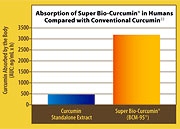
| Please Note **** Curcumin alone is not well-absorbed. The Life Extension Foundation and other companies combine curcumin with a black pepper product to significantly enhance absorption. Curcumin dosage has not been determined and is in the process of being patented by drug companies in novel bioavailable forms. |
Updates Chemopreventive Agents |

- 1. Aggarwal BB et al., Curcumin Suppresses the Paclitaxol-Induced Nuclear Factor-kB
Pathway in Breast Cancer Cells and Inhibits Lung Metastasis of
2. Ahn KS et al., Transcription Factor NF-kappa B: A Sensor for Smoke and Stress Signals,
Ann NY Acad Sci 2005.
of Cell Proliferation and Antiapoptotic and Metastatic Gene Products Through Suppression of I
Kappa Balpha and AKT Activation, Mol Pharmacol 2006
4. Lev-Ari S et al., Down-Regulation of Prostaglandin E 2 by Curcumin is Correlated with
Inhibition of Cell Growth and Decline in Apoptosis in Human
Colon Carcinoma Cell Line, J soc Integ Oncol 2006.
5. Aggarwal BB et al., Cucumin Suppress the Paclitaxol-Induced Nuclear Factor-kB Pathwayin
Breast Cancer Cells and Inhibits Lung Metastasis of Human
Breast Cancer in Nude Mice, Clinical Cancer Research 2005
6. Aggarwal BB et al., Curcumin Suppresses the Paclitaxol-Induced Nuclear Factor-kB Pathway
in Breast Cancer Cells and Inhibits Lung Metastasis of Human Breast Cancer in Nude Mice,
Clinical Cancer Research 2005.
- Please consult your licensed health care practitioner before implementing any health strategy.
The information provided on this site is designed to support, not replace, the relationship that
exists between a patient/site visitor and his/her existing physician. This site accepts no
advertising. The contents of this site are copyrighted 2004-2015 by Breast Cancer Choices,
Inc., a 501 (c) (3) nonprofit organization run entirely by unpaid volunteers.
Contact us with comments or for reprint permission at admin@breastcancerchoices.org

Want to chat with fellow patients? Join our online email discussion group Click here. |
| . |

| . |
| Home FAQ Strategies Discussion Iodine Hormones Contact Store |